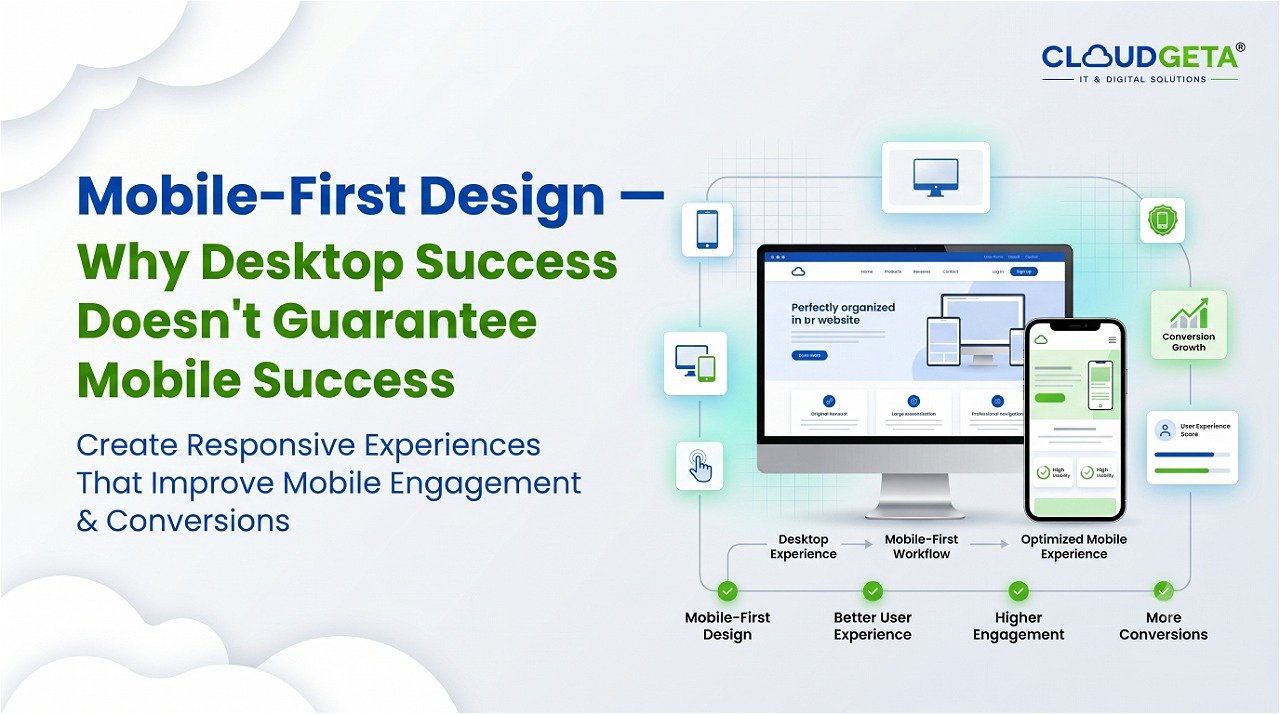
Your website looks professional on your laptop. Desktop visitors have decent experience. Mobile visitors bounce immediately.
This is because you designed for desktop first. You optimized for large screens. Mobile became an afterthought.
Mobile-first design flips this approach. You design for mobile first. Then you enhance for larger screens.
Why does this matter? Sixty to seventy percent of your visitors use mobile. If mobile experience is terrible, you lose most of your audience.
Mobile design is constrained. Smaller screen. Touch instead of mouse. Slower connections. Limited attention span. Mobile users are on the go. They want information fast. They want tasks to be easy.
Mobile-first design forces clarity. You cannot include everything on mobile. You must prioritize. What is truly essential? That becomes the mobile experience. Everything else is secondary.
This constraint actually improves design overall. When you are forced to prioritize for mobile, you create a cleaner, simpler experience. Then you add enhancements for desktop. The result is often better than designs that optimized for desktop from the start.
Practical mobile considerations: font size must be readable without zooming. Buttons must be finger-sized (at least 44×44 pixels). Forms must be simple. Images must load quickly. Videos should auto-play muted. Navigation should be simple.
Test on actual mobile devices. Do not just resize your browser. Mobile browsers have different capabilities. Slow connections behave differently. Actual testing reveals problems emulation misses.
Performance is critical on mobile. A site that loads in one second on desktop might take four seconds on mobile with typical data connection. Every second of delay reduces conversion.
At CloudGeta, we design mobile-first websites that work beautifully on mobile devices, then enhance the experience for desktop and tablet users.